A search for a hipster barber Brooklyn men can rely on is rarely just about finding a trendy room or a quick freshen-up. It is about finding a barber who understands proportion, texture, personal style, and the practical reality of your week. Your haircut has to look sharp walking out of the shop, but it also has to hold its shape at work, on a date, after a commute, and three weeks later.
In Williamsburg and the surrounding neighborhoods, style tends to be individual rather than uniform. Some men want a crisp skin fade with a clean beard line. Others need a scissor-led cut that lets natural texture do the work. The strongest grooming results come from precision and restraint, not from chasing every passing look.
What a Hipster Barber in Brooklyn Should Actually Offer
The word “hipster” can suggest a certain aesthetic: intentional, slightly undone, and confidently personal. But a quality barbershop experience should go beyond a particular haircut or dress code. It should begin with a real consultation and end with a cut that suits the man wearing it.
That means your barber pays attention to your face shape, hair density, growth patterns, daily routine, and how much styling time you are willing to put in. A high-volume approach can produce a decent cut quickly, but it leaves little room for those details. Premium grooming is more considered. The pace allows for clean sectioning, balanced blending, refined edges, and adjustments as the shape develops.
A good barber will also be direct. If a reference photo will not translate well to your hair type or maintenance preferences, you should hear that before the clippers come out. The goal is not to copy someone else’s haircut. It is to create a version that looks natural, polished, and easy to maintain on you.
Precision Matters More Than a Trendy Look
There is nothing wrong with a current style, whether that is a textured crop, a close fade, a longer top, or a relaxed scissor cut. The question is whether the cut is technically sound. A sharp look depends on the details most people may not immediately name: the transition through the sides, the weight left at the crown, the balance between beard and haircut, and the way the neckline grows out.
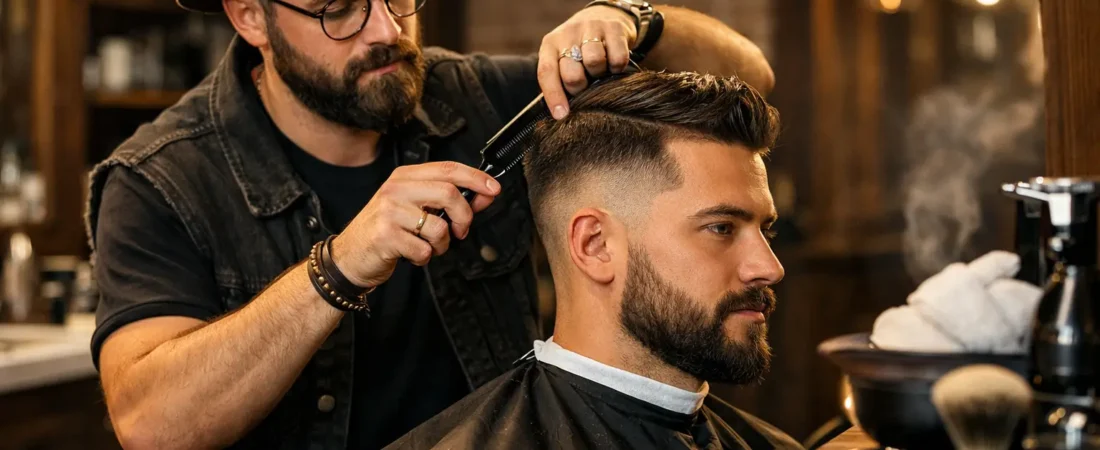
A skin fade, for example, needs a clean progression from bare skin to darker hair without visible lines or uneven patches. It can look bold and modern, but it requires regular upkeep. For men who prefer more time between visits, a taper fade can be the better choice. It keeps the edges neat while allowing a softer, more natural grow-out.
Scissor cuts bring a different kind of refinement. They are especially useful for medium-length and long hair, curls, waves, and styles that need movement instead of hard contrast. Rather than taking hair down to a single clipper length, the barber shapes the cut to work with the hair’s natural direction. The result can feel less obvious, but it is often more versatile.
The best option depends on your hair and your routine. A barber’s job is not to steer every client toward the same finish. It is to explain the trade-offs clearly and execute the right plan with care.
The consultation is part of the haircut
A precise haircut starts before the cape goes on. Bring up what you liked and did not like about previous cuts. Mention if your hair gets bulky around the sides, if your cowlick fights a certain direction, or if you need to look polished with minimal product in the morning. These are useful details, not small talk.
If you have a style reference, use it as a starting point rather than a strict instruction. Photos help establish length, shape, and overall mood, but they cannot account for every difference in hair texture and growth pattern. An experienced barber can translate the idea into a cut that fits your features.
You should also be honest about maintenance. A tight fade may need attention every two or three weeks to stay especially crisp. A longer, textured shape might hold for four to six weeks, depending on your hair. There is no right answer, only the standard you want to maintain.
A Clean Fade Is Only One Part of the Finish
Fades receive a lot of attention because the visual impact is immediate. Yet the finish around the ears, neckline, sideburns, and beard often determines whether a haircut looks merely fresh or fully put together. Those details create structure without making the result look overworked.
For men with facial hair, the haircut and beard should be treated as one composition. A beard trim can sharpen the cheeks, define the neckline, reduce bulk, and bring the proportions of the face into balance. The right amount of taper through the sideburn helps connect the haircut to the beard without an abrupt break.
A straight razor shave or hot towel treatment adds another level of care for clients who appreciate the traditional side of barbering. It is not an everyday necessity for everyone. If your skin is sensitive or you prefer a closely maintained beard, it may be a service worth building into your routine. For others, a precise beard trim and a clean neckline are all that is needed.
This is where personalized service matters. Luxury grooming should never mean adding steps that do not suit the client. It means choosing the services that make sense and performing them with attention.
Finding the Right Fit for Your Routine
The right barbershop should feel comfortable without becoming casual about the work. You want an environment where you can discuss what you want, trust the guidance you receive, and take a break from the pace outside. For professionals, creatives, entrepreneurs, and hospitality workers across Williamsburg, East Williamsburg, Bushwick, Greenpoint, and Bedford-Stuyvesant, that combination has real value.
Consider what you need from each visit. If you wear your hair short, consistency in the fade and neckline may be the priority. If you are growing it out, you need a barber who can preserve length while removing the weight that causes the shape to fall flat. If you wear a beard, you may need regular cleanups between full haircuts.
A strong barber relationship also improves over time. Once your barber understands how your hair grows and how you like it styled, each appointment becomes more efficient without becoming rushed. There is a shared reference point, but there is still room to adjust for the season, a new job, a special event, or simply a change in preference.
Questions worth asking before the cut begins
You do not need a long script at the chair. A few clear questions can establish the right direction. Ask how the style will grow out, how often it will need maintenance, and what product or styling approach will realistically support it at home. If you are deciding between a skin fade and taper, ask which one better fits your preferred schedule.
It is also reasonable to ask how much length should remain on top and where the blend should sit. These details affect the whole silhouette. A lower fade can feel more classic and controlled, while a higher fade creates stronger contrast. Neither is automatically better. Your head shape, hair density, and desired finish should guide the decision.
Grooming That Looks Considered, Not Forced
The most effective men’s grooming has an ease to it. The cut is clean, the beard is intentional, and the styling supports the hair rather than fighting it. A matte finish may suit a textured crop or relaxed quiff. A lighter cream can bring control to longer hair without stiffness. A barber can recommend a direction, but the final routine should be simple enough that you will actually use it.
Avoid treating every appointment as a full reinvention. Small refinements often make the biggest difference: taking weight out of the sides, bringing the beard into better proportion, softening an overgrown neckline, or adjusting the top so it sits correctly without excess product. These choices help your style feel current while remaining personal.
At Gentlemen’s Barbershop, the focus is on that balance: classic barbering standards, modern technique, and the time required to get the details right. Walk in when your schedule allows or book ahead when you want a set time, then arrive with a clear sense of how you want to feel when you leave.
A well-chosen haircut should make the rest of getting ready simpler. Give your barber the honest details about your hair and routine, and let precision do the rest.